Tuesday, 15 February 2011

post 8

Synopsis of the Whole Film
The film follows Nick, starring James Lyons, through an emotional journey in which he attempts to save the life of his dying daughter, starring Kelly Brown, by funding a lifesaving operation. He is a successful businessman and this financial goal is easily achievable for him, until he allows the stress of his daughter’s illness to interfere with the quality of his work and he is fired from his role in the company.
From this, his life begins to spiral out of control as he uses the controversial drug trade and other illegal methods to fund his daughters operation but after becoming addicted to the substances he formerly sold, he was incapable of prioritizing his savings. His daughter ultimately passes away which results in a prolonged battle with schizophrenia and eventually the dramatic ending.

Synopsis of the Title Sequence
The main character, Nick, starring James Lyons, will be shown running in various locations. He will also be shown panicking over the voices that he can hear whilst he’s running. As Nick is running, there will be scenes which reveal the titles and will be superimposed in the editing process. At the end of the title sequence, Nick is shown contemplating shooting himself as Raoul enters the shot, and the audience feel obliged to watch the whole film to discover which character dies. At this moment, the screen will black out and the title of the film will appear on a black screen.

Time line


Shot List


Storyboard & technical detail


Risk Assessment
It’s important to perform a risk assessment so that we are prepared for the filming stage and making sure everyone is safe. Listing all potential hazards also ensures that everyone is aware of the dangers and also what can be done to prevent these.


Crew List
We also decided to create a crew list describing the roles of each member of the project for each scene, and any additional props or equipment that is needed.


Locational and Technical Reece
In order to prepare for the filming process we photographed the locations which we were going to use as our set and later analyzed various aspects of that location and the effects that it could have on the film. This is the conclusions that we made:


#



post 7


We asked diffrent ages and genders about our idear for our opening and this is what we got.
Working off of this we changed the end to our opening, to encorpurate there feedback.

Sunday, 13 February 2011

post 6

Most popular genres have a history. The crime film so many that it is near impossible to give a straightforward account of the genre's evolution without getting lost in innumerable byways as different crime formulas arise, evolve, compete, mutate, and cross-pollinate. Crime films arise from a radical ambivalence toward the romance of crime. That romance gave heroic detectives like Sherlock Holmes—burlesqued onscreen as early as 1900 or 1903 (the exact date is uncertain), in the thirty-second Sherlock Holmes Baffled —a matchless opportunity to make the life of the mind melodramatic and glamorous, and it made silent criminals like Fantômas and Bull Weed ( Underworld , 1927) both villain and hero. The arrival of sound in 1927 and the Great Depression in 1929 created an enormous appetite for escapist entertainment and a form of mass entertainment, the talkies, capable of reaching even the most unsophisticated audiences, including the millions of lower-class immigrants who had flocked to America. The great gangster films of the 1930s and the long series of detective films that flourished alongside them, their detectives now increasingly ethnic ( Charlie Chan Carries On , 1931, and forty-one sequels; Think Fast, Mr. Moto , 1937, and seven sequels; Mr. Wong, Detective , 1938, and four sequels), were nominally based on novels. But crime films did not seek anything like the literary cachet of establishment culture until the rise of film noir—atmospheric tales of heroes most often doomed by passion—named and analyzed by French journalists but produced in America throughout the decade beginning in 1944.


Postwar crime films, whatever formula they adopted, were shaped in America by cultural anxiety about the nuclear bomb ( Kiss Me Deadly , 1955) and the nuclear family ( The Desperate Hours , 1955). The decline of film noir after Touch of Evil (1958) was offset by a notable series of crime comedies at England's Ealing Studios (such as The Lavender Hill Mob , 1951) and a masterly series of psychological thrillers directed by Alfred Hitchcock ( Strangers on a Train , 1951; Rear Window , 1954; Vertigo [left] , 1958; North by Northwest , 1959; Psycho , 1960). The 1960s was the decade of the international spy hero James Bond, who headlined history's most lucrative movie franchise in a long series beginning with Dr. No (1962). But it was left to a quartet of ironic valentines to retro genres, Bonnie and Clyde (1967), The Godfather (1972), The Godfather: Part II (1974), and Chinatown (1974), to reinvent the crime film for a hip young audience. The replacement of the 1930 Production Code by the 1969 ratings system allowed niche films to be successfully marketed even if they were as graphically violent as Henry: Portrait of a Serial Killer (1990) or as bleak in their view of American politics as The Parallax View (1974) or JFK (1991). The closing years of the century, marked by a heightened public fear of crime, a fascination with the public-justice system, and a deep ambivalence toward lawyers, allowed a thousand poisoned flowers to bloom around the globe, from the sociological sweep of the British television miniseries Traffik (1989), remade and softened for American audiences as Traffic (2000), to the ritualistic Hong Kong crime films of John Woo ( Hard boiled [ poster on the left]) and Johnny To ( Dung fong saam hap [The Heroic Trio], 1993) and their American progeny ( Pulp Fiction , 1994), to the steamy eroticism of the all-American Basic Instinct (1992) and its direct-to-video cousins. Perhaps the most distinctive new strain in the genre has been the deadpan crime comedy of Joel (b. 1954) and Ethan (b. 1957) Coen, whose films, from Blood Simple (1985) to The Ladykillers (2004), left some viewers laughing and others bewildered or disgusted.


Themes
· Rivalry- usually with other criminals. Often regarding money, pride or loyalty or gang hate.

· Morality- as religion is used as a key aspect, usually used as dramatic irony or to highlight their lack of morals. This can be seen in films such as Goodfelles.

· Betrayal- huge theme of giving up information to crime families or police. Can be to do with frustration or most commonly, will go to prison otherwise

· Fierce ambition- protagonist is usually full of desire, sometimes resulting in his death or attaining ultimate power

· Materialism- most focus on material aspects, for example cars represent ultimate fantasyof rags to riches

· Self destruction- obtain everything they desire but they become complacent and bored, leading to a big downfall

· Evil- the protagonist can appear evil, clinical and sinister as death is portrayed as a business with no care or doubt

· Loyalty- undying loyalty between the mob, shown with how they consider them to be ‘family’, such as The godfather.


Symbols are used throught the crime genre. Here are the key ones :
· Money, epitomizes materialism and a crime films ultimate desire.
· Guns and ammo, represents violence and most prevalent weapon used in a crime film
· Police, represent the law which is everything the mob hates and fights against, epitomize the ultimate enemy
· Locations, the two main styleof location are poler extreams. Most crime films are ether set in hot, sunny America ( such as the film True Romance) or dirty back allys and streets (such as trainspotting).

post 5a


post 5

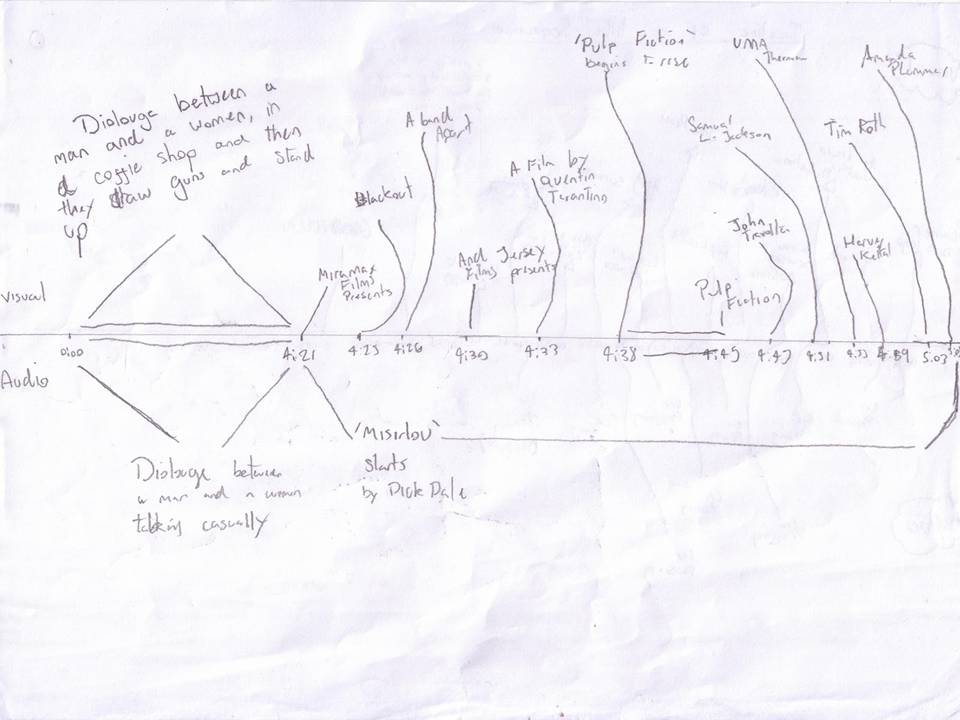
As a group, we decided to create a detailed timeline of the visual parts of the title sequence for the film Goodfellas, Se7en, The Dark Knight and Pulp Fiction as well as a description of the audio which matched up with the visuals


Tuesday, 25 January 2011

main post 4


The conclusion we made from this conversation was that the main character, acted by an older person, will be shown running in various locations. He could possibly be hearing voices and having hallucinations of his dead daughter to portray his schizophrenic mental disorde, but at this point in time we are not sure if this will fit the crime genre. As the main character is running, there will be posters and signs that would be seen in such a location with the credits displayed. At the end of the title sequence, the main character is shown holding a gun and the man chasing him is also hlding a gun. At this moment, the screen blacks and we hear a gun shot with the title appearing on a black screen, leaving the audience in serspence.

main post 3a

For my further look at opening sequences I decided to look at ‘Reservoir Dogs’. I chose to look at this as it follows the conventions of a crime film, linking with our genre. The opening shot shows us a group of people sitting around a table talking about the meaning behind the song ‘About a virgin’. This straight away grabs the audience’s attention and appeals to the target audience by making them laugh. It is clear that Quentin Tarantino had a definite audience in mind, which consists of mainly males. This opening scene therefore apples to a male audience because it shows and creates a male bonding.

All the characters are wearing black suits and ties. This modern gangster look was not a huge convention at the time and had rarely been seen before, but instead arguably set the convention of this dress code for future films and played a huge inspiration on our film. The camera revolving around the table rather then giving us a establishing shot of the café or the gang sitting around the table, immediately immerses us within the conversation and therefore film, setting up questions from the start such as who are these people?

Both the dress code and the way that the men are acting and talking hold this ‘cool’ feel to it and this helps to get a male audience to show a positive response. The downside to all these elements, such as the film starting in mid conversation and setting up new genre conventions, are that some audience members seeing this film for the first time, especially in 1992 when it was released, might feel confused and alienated.

When they leave the café a title screen appears and a radio presenter kicks in. We then see the gang walking down the street with the non-dietetic sound of 70’s music playing. This music, the slow motion scene and the yellow titles give the film a 70’s exploitation crime feel to it.